If you’re importing or sourcing office chairs, two acronyms will keep coming up: BIFMA X5.1 and EN 1335. They are the reference standards for office seating in North America and Europe, respectively. Buyers often assume they’re interchangeable. They are not — they cover different things, and the standard your destination market expects determines what testing your product actually needs.
Here’s a plain-English breakdown of what each standard covers, how they differ, and how to decide which one applies to you.
The Short Answer
- ANSI/BIFMA X5.1 is a North American standard that focuses on structural performance, durability, and safety — how much load a chair can take and how many cycles it survives before failing.
- EN 1335 is the European standard that covers ergonomic dimensions and safety — it prescribes the size ranges and adjustability a compliant office work chair must offer, in addition to safety testing.
The simplest way to remember it: BIFMA mainly asks “will it survive?” while EN 1335 also asks “does it fit the user correctly?” Many quality manufacturers test to both so a single product can serve both markets.
What Is ANSI/BIFMA X5.1?
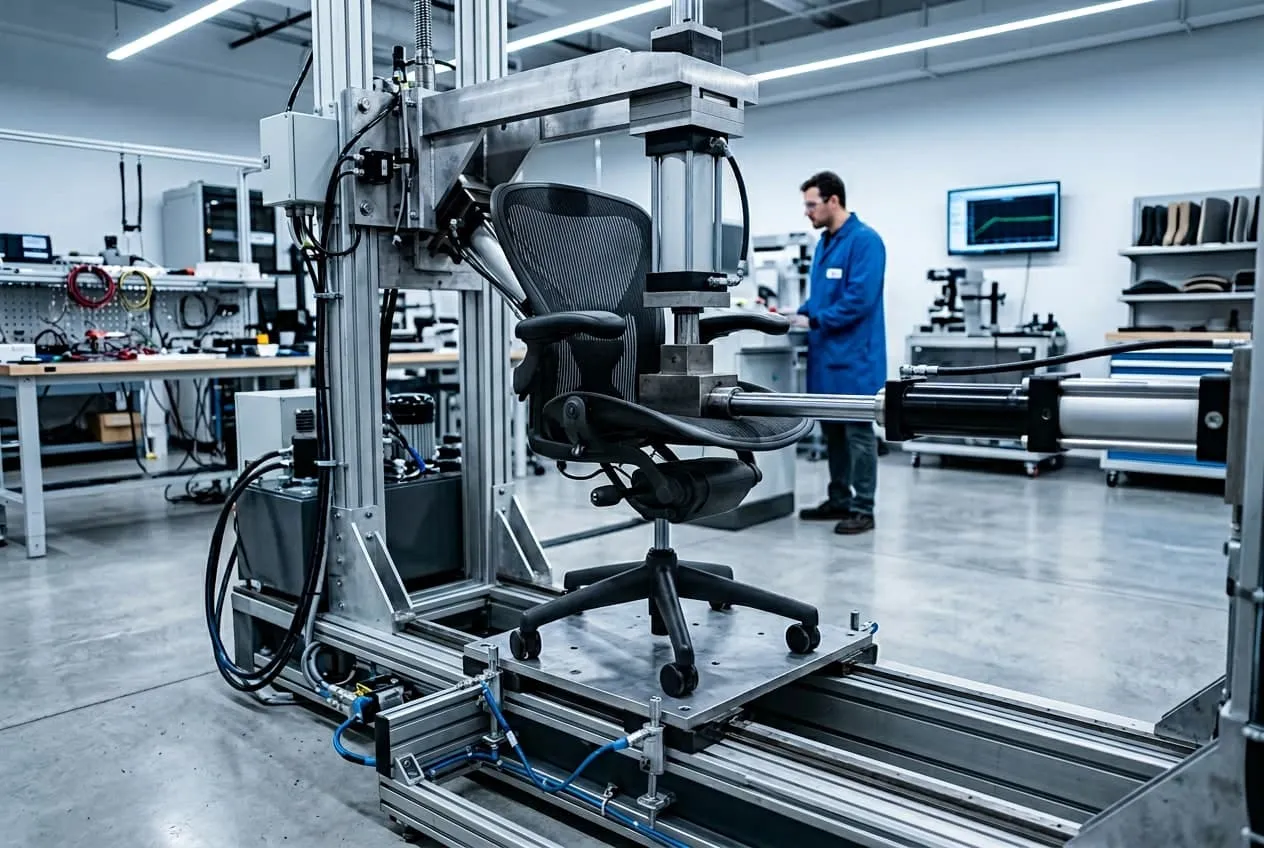
BIFMA stands for the Business and Institutional Furniture Manufacturers Association, the North American industry body. ANSI/BIFMA X5.1 — General-Purpose Office Chairs — Tests defines a battery of laboratory tests that measure how a chair performs under stress over time.
Typical areas it evaluates include:
- Backrest strength — force applied to the back to confirm it won’t fail under load
- Seat and base durability — repeated cycling to simulate years of daily use
- Stability — resistance to tipping front, rear, and sideways
- Caster and base durability — wear testing on the wheels and five-star base
- Drop tests — impact resistance of the seat
- Arm strength — vertical and horizontal load on armrests
X5.1 is fundamentally a performance and safety standard. It tells a buyer the chair is built to survive real-world use. It does not, on its own, prescribe ergonomic dimensions — those are addressed separately in North America (for example, by ANSI/HFES 100 and BIFMA’s ergonomics guidance).
What Is EN 1335?
EN 1335 is the European Standard titled Office furniture — Office work chair. It is published in three parts, and that structure is the key to understanding it:
- EN 1335-1: Dimensions — defines the measurable dimensions and the adjustment ranges a compliant chair must offer. It groups chairs into size types (commonly referred to as Type A, B, and C) covering different ranges of seat height, seat depth, and backrest height.
- EN 1335-2: Safety requirements — the safety criteria the chair must meet.
- EN 1335-3: Test methods — the laboratory procedures used to verify safety and strength.
The crucial point: EN 1335 builds ergonomic dimensions directly into the standard. A chair sold as EN 1335-compliant has to provide specified adjustability so it fits a defined range of users — not just survive durability testing. This reflects Europe’s stronger regulatory link between office seating and workplace health requirements.
BIFMA X5.1 vs EN 1335: Side by Side
| Aspect | ANSI/BIFMA X5.1 | EN 1335 |
|---|---|---|
| Region | North America | Europe / EU |
| Primary focus | Structural performance, durability, safety | Ergonomic dimensions + safety |
| Prescribes seat/back dimensions? | No (handled by separate ergonomics standards) | Yes — Type A/B/C size ranges |
| Durability / cycle testing | Core of the standard | Covered in Part 3 (test methods) |
| Stability & strength testing | Yes | Yes |
| Best understood as | ”Will it survive?" | "Will it survive and fit the user?” |
| Common buyer requirement in | USA, Canada | EU member states, UK, much of Europe |
Which Standard Do You Actually Need?
It comes down to your destination market:
- Selling into North America? Buyers, distributors, and institutional purchasers (offices, government, education) typically expect BIFMA X5.1 compliance. Contract and government tenders often require it explicitly.
- Selling into Europe? EN 1335 is the reference point, especially for workplace and contract furniture, because European employers operate under workplace-ergonomics expectations that the standard supports.
- Selling into both? Test to both. The two standards aren’t in conflict — a well-engineered chair can satisfy both, and dual compliance widens the markets you can serve from a single product.
A common mistake is assuming one certificate covers everything. A chair tested only to BIFMA may not meet EN 1335’s dimensional requirements, and vice versa. Confirm the requirement with your buyer or the tender documents before production, not after the container has shipped.
A Note on Testing Bodies vs Standards
One frequent source of confusion: a standard is not the same as a testing lab. BIFMA X5.1 and EN 1335 are the standards (the rules). Independent laboratories such as SGS test products against those standards and issue reports. So a product can be “tested to BIFMA X5.1 by SGS,” for example — the standard defines the test, the lab performs it.
When you ask a supplier for compliance documentation, you want to see which standard was tested, which lab performed it, and the test report or certificate itself — not just a verbal claim.
How CXstyle Approaches Standards
CXstyle designs and manufactures office seating in Tainan, Taiwan, with products tested to recognized international standards including BIFMA X5.1, EN 1335, and verification by SGS. Because we serve importers across North America, Europe, and Asia-Pacific, building to internationally recognized standards is part of how we work, not an afterthought.
You can read more on our certifications page, explore our office mesh chair range, or review our in-house capabilities.
Frequently Asked Questions
Is BIFMA or EN 1335 stricter?
Neither is simply “stricter” — they emphasize different things. BIFMA X5.1 is rigorous on structural durability and safety. EN 1335 adds prescribed ergonomic dimensions on top of safety testing. A chair can pass one and not meet the other’s specific requirements.
Do I need both BIFMA and EN 1335 certification?
Only if you sell into both North America and Europe. If you serve a single market, the standard for that region is usually sufficient. When in doubt, check your buyer’s purchasing requirements or the tender specification.
Is SGS a standard or a testing company?
SGS is an independent testing and inspection company, not a standard. It tests products against standards like BIFMA X5.1 and EN 1335 and issues the corresponding reports.
Can the same office chair meet both BIFMA X5.1 and EN 1335?
Yes. The standards are not in conflict, and well-engineered chairs are frequently tested to both so one product can be sold in multiple markets. Dual testing is common for manufacturers serving global buyers.
How do I get a product tested to these standards?
Testing is arranged through an accredited laboratory, and the exact scope depends on your product and target market. For guidance on which standards your project should target and how documentation is handled, contact our team.
Not sure which standard your market requires? The right testing scope is confirmed per project and destination. Contact CXstyle to discuss your target market and compliance needs — we’ll help you scope it correctly before production starts.