If you’re sourcing children’s study chairs for retail, e-commerce, or school contracts, it’s tempting to treat them as scaled-down office chairs. They are not. A kids’ study chair answers to a different set of safety standards, a different ergonomic problem — a body that’s still growing — and a different buyer expectation around adjustability and material safety.
For importers and private-label brands placing an OEM kids’ study chair order, getting the specification right upfront is what separates a product that sells and passes customs from one that gets stuck at the border or returned by parents. Here’s a plain-English guide to what matters.
Why a Kids’ Study Chair Is Its Own Product Category
An adult office chair is engineered around one fixed adult frame and tested to office-furniture standards like BIFMA X5.1 or EN 1335. A children’s chair has two problems an office chair never faces:
- The user keeps growing. A chair bought for a six-year-old may need to serve the same child at eleven. That’s the entire reason “a chair that grows with the child” is the central selling point in this category.
- The user is a child. That triggers a completely different safety regime — toy-safety and school-furniture standards covering chemical migration, small parts, sharp edges, and tip-over resistance, none of which appear in office-chair testing.
So the right reference points aren’t BIFMA or EN 1335. They’re the children’s product standards below.
The Safety Standards That Actually Apply
Compliance is destination-driven. The certificate that clears a shipment into Germany is not the one US customs wants to see. Map the standard to the market before you finalize the spec:
- European Union — EN 71 (toy safety): part 1 (mechanical/physical), part 2 (flammability), and part 3 (migration of certain elements, i.e. heavy metals). Plus EN 1729-1 / -2 for school chair dimensions, stability, and strength.
- United States — CPSIA (lead per Section 101, phthalates per Section 108) and ASTM F963 (toy safety).
- Australia / New Zealand — AS/NZS ISO 8124 (safety of toys).
A few things importers routinely underestimate:
- Chemical safety is per material, not per chair. Every plastic, foam, fabric, and coating has to pass migration limits for lead, cadmium, phthalates, and BPA. A “compliant” frame paired with an untested fabric is not a compliant chair.
- Small parts are a choking-hazard test. Any removable component — a press-in armrest cap, a caster, a logo plug — has to pass the small-parts cylinder test if the chair is rated for younger children.
- Tip-over resistance is mandatory, not optional. A wide-stance five-star base with a low center of gravity passes the EN 1729-2 stability requirement. A narrow or top-heavy design will fail it.
The Variants Buyers Actually Ask For
When buyers search for an OEM kids’ study chair, they’re usually after one of a handful of feature configurations. Knowing which one fits your channel saves a round of back-and-forth at the quote stage:
- Study chair with armrests (or removable armrests). Removable armrests are popular because they let one chair tuck under a low desk or pull up to a taller one — and they widen the age range a single SKU can serve. The trade-off: every removable part is one more small-parts and durability test point.
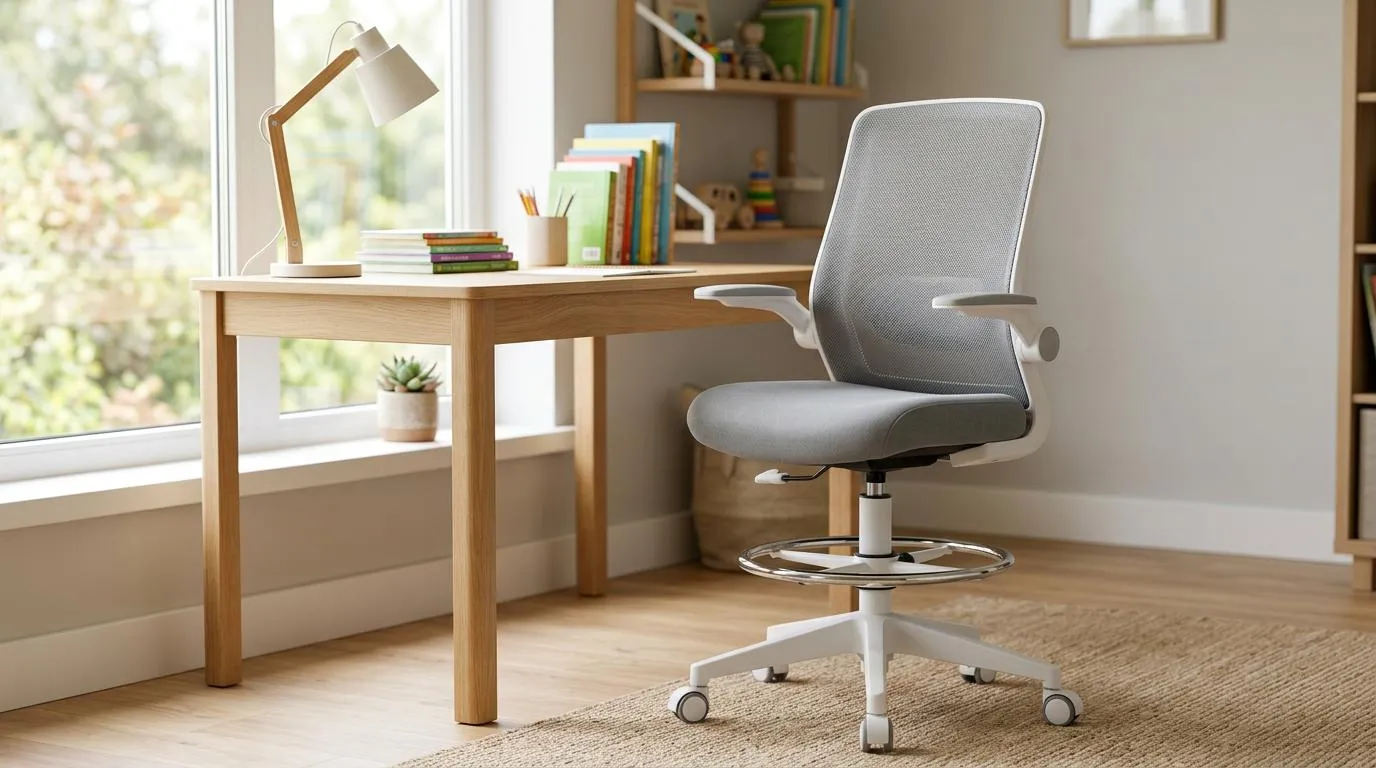
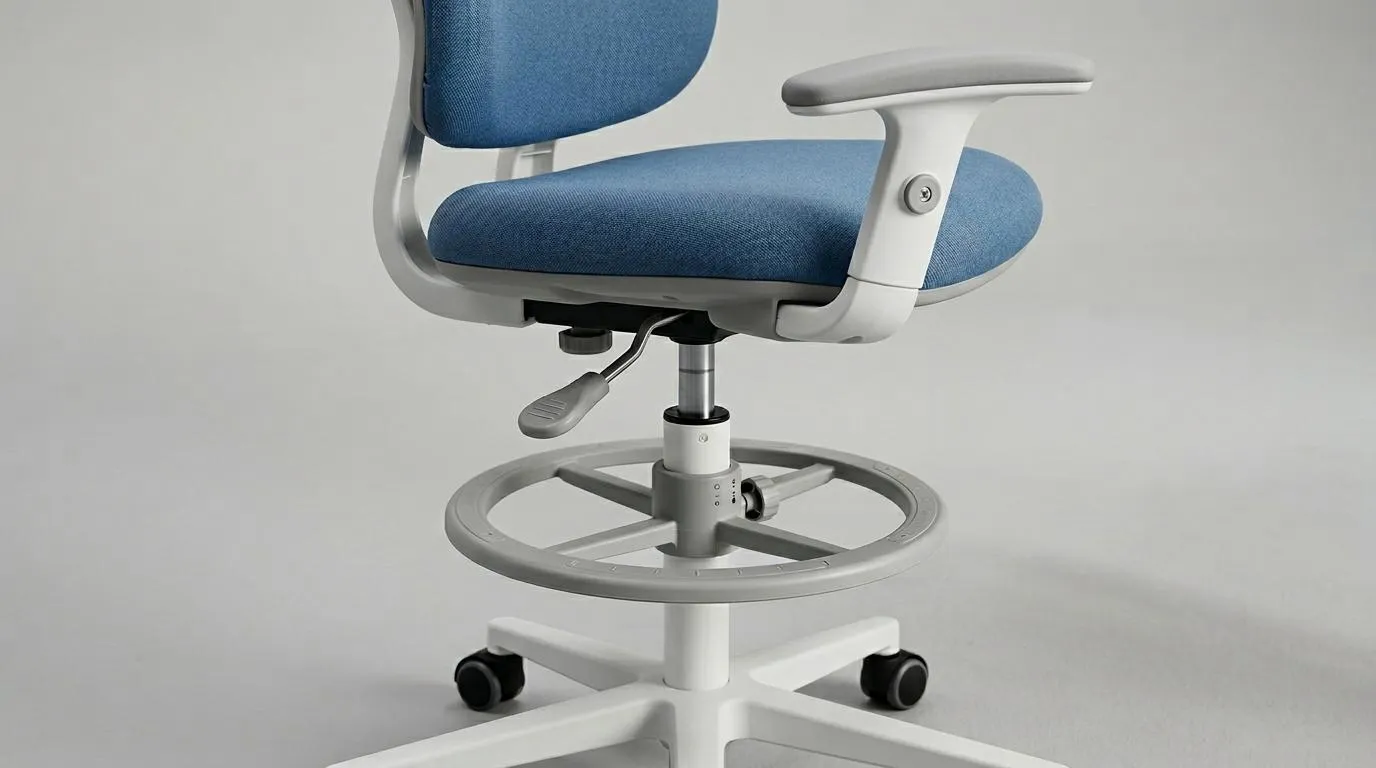
- Study chair with footrest. For a child whose feet don’t reach the floor, an adjustable footrest is the single most important ergonomic feature — it’s what keeps the hips and lower back supported instead of dangling. On a “grows-with-the-child” chair, the footrest height should adjust together with the seat.
- High-back children’s chair. A higher backrest adds upper-back and shoulder support for longer study sessions; it’s the format parents associate with a “serious” study chair rather than a play stool.
- Tall children’s chair. Marketed for older or taller kids, this is usually the upper end of the same adjustable platform rather than a separate frame — worth clarifying so you don’t over-tool.
- Mesh-back study chair. A breathable mesh back runs cooler over long sitting periods and reads as more premium in retail photography. It’s a material-and-tooling choice that’s quoted per project.
Most of these aren’t separate products — they’re configuration options on one adjustable platform. The smart move is to pick the platform first, then decide which variants your catalog needs.
Adjustability: The Core of the Category
The defining feature of a study chair is that it adapts to a growing body. A well-designed adjustable platform typically covers seat height in the 38–52 cm range with a matching adjustable footrest, which is enough to serve a child from roughly age 4 through the early teens on a single chair. That single-SKU-fits-many-ages property is exactly what makes the category attractive for retail and e-commerce — one product photo, one listing, a wide buyer pool.
Contract and institutional sales work differently. School procurement usually follows EN 1729-1, which defines a series of color-coded size marks matched to pupil height, so a classroom is fitted with fixed-size chairs matched to each age cohort rather than one adjustable chair per pupil. If you’re bidding school contracts, you’re sourcing size-coded fixed chairs; if you’re selling to homes, you’re sourcing the adjustable platform. Decide which channel you’re in before you spec.
OEM vs ODM, and What You Can Customize
If the OEM-versus-ODM distinction is new to you, our OEM vs ODM chair manufacturing guide covers it in full. In short: ODM means you adapt an existing, already-certified platform; OEM means a more bespoke build. For children’s chairs, starting from a certified platform is almost always the faster, lower-risk route to market — the safety testing is the long pole, and an existing platform has already cleared it.
Typical customization on a children’s study chair includes:
- Shell and frame color matching to your brand palette
- Upholstery color and material (including mesh-back options)
- Logo application — silk-screen, heat-transfer, or pad-print, usually on the backrest
- Retail vs contract packaging — a printed color box for shelf and e-commerce, or a plain mono-carton with master pack for contract volume
Setup fees, tooling, minimum quantities, lead times, and sample charges all depend on how much of the above you change. Those numbers are confirmed per project, so talk to us with your target SKU and volume rather than relying on a generic price list.
A Sourcing Checklist for Importers
Before you commit to an OEM kids’ study chair order, run through this:
- Confirm the certification scope for every destination market — EU needs EN 71 + EN 1729; the US needs CPSIA + ASTM F963; Australia/NZ needs AS/NZS ISO 8124. Selling into more than one region means meeting the strictest of them.
- Ask for a batch test report, not a generic certificate. A real third-party lab report on your production batch is what protects you in a customs hold or a recall. Lab reports are typically valid for 12 months from issue.
- Pin down the adjustability range — seat height span, footrest behavior, and the age range a single SKU actually covers. This is your headline marketing claim, so it has to be true.
- Check small-parts and sharp-edge compliance on every removable component if the chair targets younger children.
- Specify the packaging channel upfront — retail color box vs contract mono-carton changes cost, master-pack count, and how the chair photographs on a marketplace listing.
- Match the format to the channel — adjustable platform for home/retail, EN 1729 size-coded chairs for school contracts. Don’t try to sell one into the other.
For a broader walkthrough of finding and vetting a Taiwan supplier end to end, see our step-by-step sourcing guide.
How CXstyle Manufactures Children’s Study Chairs
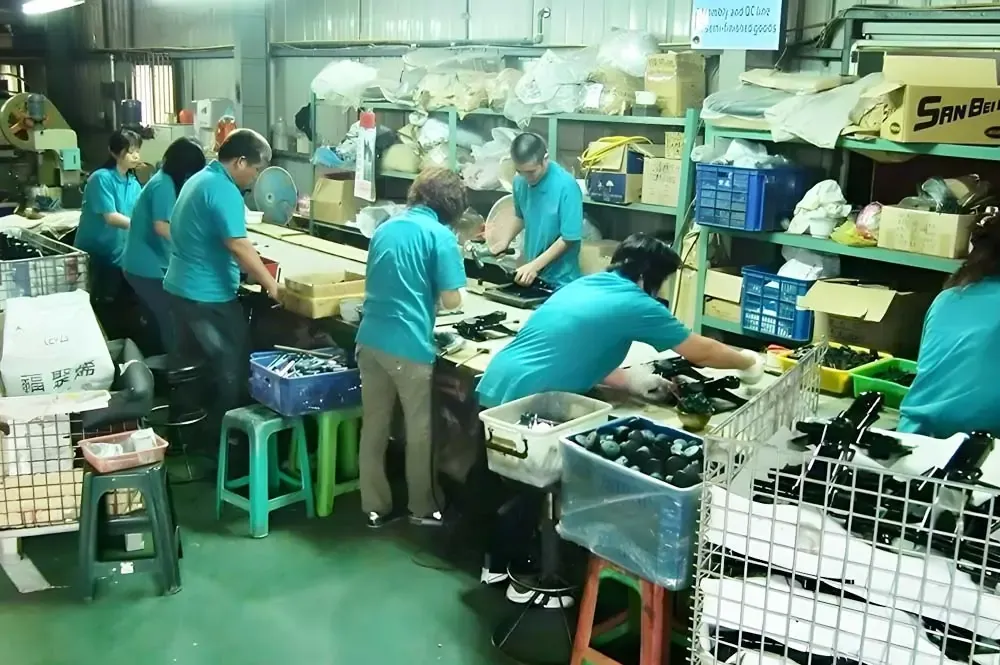
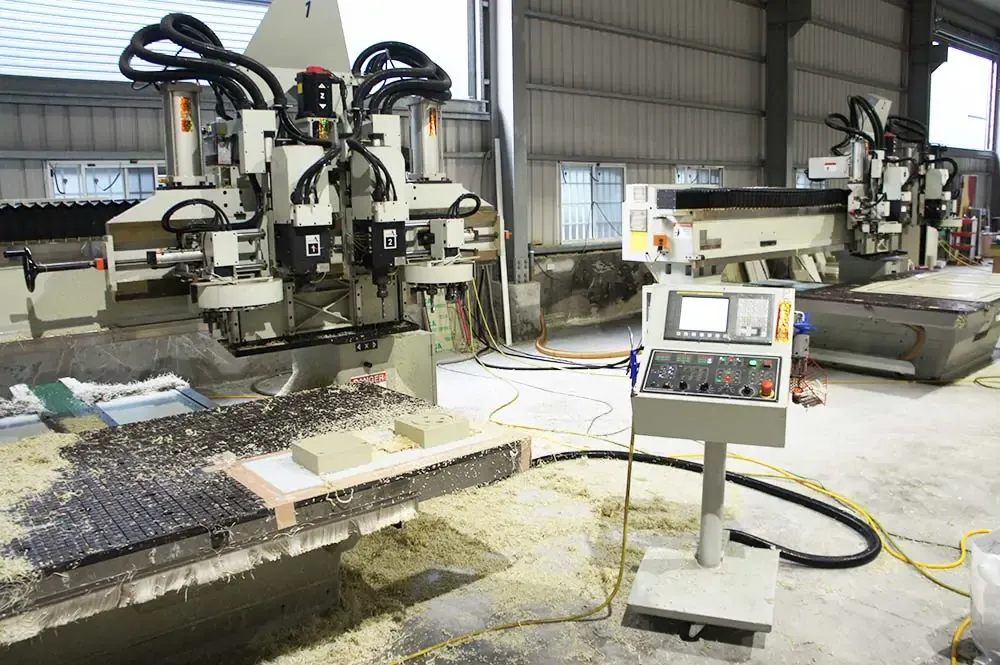
CXstyle has manufactured seating in Tainan, Taiwan since 1990, with in-house injection molding, metal punching, CNC machining, sewing, and soft-material cutting under one roof — which means tooling, material safety, and assembly are controlled in the same facility rather than scattered across subcontractors. Our children’s models are built to comply with EN 71-1 / -2 / -3, EN 1729-1 / -2, and ASTM F963, with adjustable seat height, adjustable footrest, removable-armrest and high-back options, mesh or upholstered backs, and an anti-tip five-star base.
Browse the children’s study chair range, review our in-house manufacturing capabilities and certifications, or read our product walkthrough on a chair that grows with your child.
Planning a children’s study chair line? Whether you need an adjustable home-study platform or EN 1729 size-coded chairs for school contracts, the right spec depends on your market and channel. Contact CXstyle with your target standards, features, and volume, and we’ll quote a build that fits.