When importers compare office chair quotes, they usually focus on the unit price and the certifications. The line that quietly moves landed cost just as much is how the chair is packed — knock-down (KD) or fully assembled. For a bulky, lightweight product like an office chair, packing method decides how many units fit in a container, and that decides your per-unit freight.
This guide explains why packaging drives freight on seating, what changes between KD and assembled, and how to think about what fits in a 20ft versus a 40ft container — without pretending there’s a single magic number.
Why Packaging Method Drives Freight on Chairs
Ocean freight for a full container (FCL) is a fixed cost for the box, so your real metric is per-unit freight = container cost ÷ units loaded. The more chairs you fit, the lower the freight on each one.
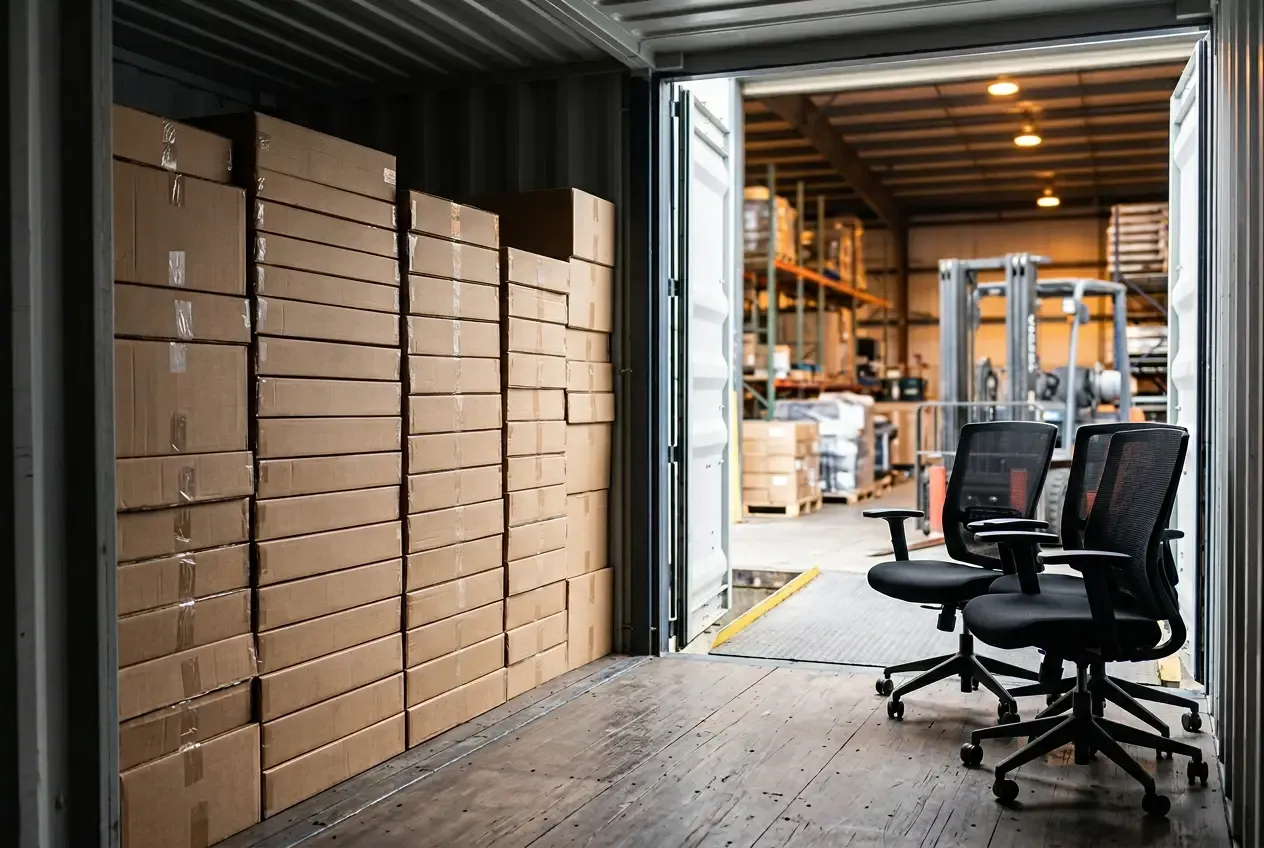
Office chairs are what forwarders call volumetric or “light” cargo — they take up a lot of space for very little weight. A container almost always cubes out (runs out of space) long before it weighs out (hits the weight limit). That single fact is why packaging matters so much: with seating, you’re paying for air unless you compress the volume.
An assembled chair is an awkward, non-stackable shape — splayed five-star base, fixed armrests, an upright backrest, a protruding gas cylinder. Those gaps between chairs are volume you’re shipping and paying for. KD packing flattens the same chair into stackable components, squeezing out most of that dead air.
KD vs Assembled: What Actually Changes
| Factor | Knock-Down (KD) | Fully Assembled |
|---|---|---|
| Volume per unit | Low — flat-packed components stack tightly | High — fixed shape leaves dead air |
| Units per container | Significantly higher | Lower |
| Per-unit freight | Lower | Higher |
| Buyer-side labor | Assembly required on arrival | Ready to use out of the box |
| Warehouse handling | Compact cartons, easy to store | Bulky, more storage space |
| Transit damage risk | Lower (fewer exposed parts) | Higher (armrests, casters exposed) |
| Best fit | Volume programs, distributors, cost-led | Drop-ship, retail, low-labor buyers |
The headline is simple: KD packing significantly increases the number of chairs per container and lowers per-unit freight. The trade-off is labor — someone assembles the chair after it lands. For a distributor moving pallets into a warehouse, that’s a non-issue. For a drop-ship or retail program where the chair ships straight to an end user, assembled may be worth the higher freight.
As a rough industry rule of thumb, a knock-down office chair often occupies less than half the shipped volume of the same chair assembled — but the exact ratio depends entirely on the model’s base, backrest, and armrest design. Treat that as directional, not a quote.
What Fits in a 20ft vs 40ft Container?
This is the question every importer asks, so let’s be precise about what can and can’t be answered up front.
The container’s capacity is a fixed, published spec. Approximate internal volumes:
- 20ft standard: ~33 CBM (cubic meters)
- 40ft standard: ~67 CBM
- 40ft High Cube (HQ): ~76 CBM
But usable volume is always lower than nominal — packing gaps, carton dimensions, and how neatly units stack mean you never fill 100% of the box. On seating, realistic utilization typically lands well below the headline figure.
That’s why a responsible manufacturer won’t quote “X chairs per container” from a product name alone. The real number depends on three things:
- The specific model — base diameter, backrest height, and armrest style change the packed cube dramatically.
- Packaging method — KD versus assembled is the single biggest lever.
- Container size — 20ft, 40ft, or 40ft HQ.
Give a supplier the model and the packing method, and they can calculate a real loadability estimate for your order. For an accurate per-container figure on a specific chair, contact us with the model and target volume — it’s a quick calculation once the spec is fixed.
How KD Packing Works on the Factory Side
KD isn’t just “leave it in pieces.” A well-designed KD chair is engineered so the seat, backrest, base, casters, gas cylinder, and armrests nest into a compact carton with the hardware and an assembly guide included. Components are protected individually, which is also why KD units tend to arrive with less transit damage than assembled chairs whose armrests and casters ride exposed.
Two packing choices interact with loadability:
- Master carton vs individual carton. Contract and bulk programs often use a master pack (several units per outer carton) to raise density; retail programs use printed individual color boxes. The channel decides the format.
- Stacking geometry. Visitor and conference chairs designed to stack are inherently space-efficient even when shipped assembled — a stacking profile can rival KD on density for that chair type. If your program is stacking chairs, KD may matter less.
When Assembled Still Makes Sense
KD isn’t automatically the right call. Assembled shipping wins when:
- You drop-ship to end users and can’t add an assembly step.
- Your buyer has no assembly labor and values ready-to-use delivery.
- The chair is a premium model where the unboxing experience matters.
The correct comparison is never freight in isolation — it’s total landed cost including buyer-side labor. A lower freight bill that adds an hour of warehouse assembly per unit may not be cheaper once labor is counted. Run the math both ways for your own operation.
Compare on Landed Cost, Not Freight Alone
Packing method sits alongside your Incoterm as the two big levers on what the goods actually cost delivered. If you’re still deciding who books and pays the ocean freight, our FOB vs CIF guide breaks down the shipping-terms side; this article covers the volume side. Together they determine your landed cost.
A practical sequence:
- Fix the model and spec so the packed cube is known.
- Decide KD or assembled based on your labor and channel.
- Get a loadability estimate for your container size.
- Layer in your Incoterm to see who carries freight.
- Compare quotes on total landed cost, normalized to the same basis.
Skip step 1 and any “chairs per container” number you’re given is a guess.
Pack It Right, Ship It Efficiently
CXstyle manufactures ergonomic office, mesh, and visitor seating in Taiwan and packs every program to the method that fits the buyer — KD for volume distributors optimizing freight, assembled or stacking for drop-ship and retail channels. We’ll run a loadability estimate for your model and container size as part of the quote.
Explore our office & mesh chair range or visitor & stacking chairs, see how packaging fits into an OEM/ODM order, or review our in-house manufacturing capabilities. When you’re ready, contact us with your model and target volume for a container loadability estimate and a project quote.